Introduction
I have been treating lawns in Northwest Arkansas for years, and fungal disease is one of the most misdiagnosed problems we see. A homeowner notices brown or yellow patches and assumes it is a watering issue. They water more. The patches get worse. Then they call us.
That is because most fungal diseases thrive in exactly the conditions that seem like the right fix for a struggling lawn: moisture and warmth. More water is often the last thing a diseased lawn needs.
Here is how to tell whether you are looking at a fungal problem, what the most common diseases in our area look like, and what to do about it.
The Pattern Tells You More Than the Color
This is the first thing I look at when I walk a lawn. Not the color of the grass. The pattern of the damage.
Drought stress browns a lawn gradually and somewhat uniformly. It follows sun exposure, slope, and soil drainage. Fertilizer burn shows up in streaks that match your spreader path. Grub damage peels back in irregular chunks.
Fungal disease has its own patterns and they are usually much more defined. Here is what to look for:
- Circular or ring-shaped patches: Brown patch and dollar spot both create distinct circular areas of damaged turf. The circles may be small as a silver dollar or as large as several feet across.
- A darker or water-soaked border: Many fungal diseases have an active outer edge where the fungus is still spreading. This border often looks darker, greasy, or slightly wilted compared to the dead center.
- Patches that appeared fast: A lawn that looked fine Monday and has a two-foot brown circle by Friday is almost certainly dealing with disease. Drought stress and nutrient problems develop over weeks. Disease can move in days.
- Thread-like webbing on the grass surface: Pink snow mold and pythium blight both produce visible mycelium, a cottony or web-like coating on the turf surface, most visible early in the morning before the dew burns off.
- Irregular tan or bleached spots: Dollar spot produces small bleached patches. Each individual spot is roughly the size of a silver dollar, but they can merge into larger affected areas as the disease spreads.
The Most Common Lawn Diseases in Northwest Arkansas
Brown Patch: The most common summer disease in our area, primarily affecting tall fescue. It shows up as circular patches of tan or brown grass with a darker smoke ring border. It hits hardest when nighttime temperatures stay above 70 degrees and humidity is high. Excess nitrogen and overwatering in summer are the biggest risk factors.
Dollar Spot: Affects both warm-season and cool-season grasses. Produces small bleached spots, each about the size of a silver dollar, that can merge into larger damaged areas. Associated with low nitrogen and dry conditions followed by heavy dew. The opposite risk profile from brown patch.
Pythium Blight: Fast-moving and aggressive. Produces greasy-looking patches that collapse quickly. Most dangerous during hot, wet stretches with poor air circulation. Can destroy large sections of fescue turf in 24 to 48 hours under ideal disease conditions.
Gray Leaf Spot: Primarily affects St. Augustine and sometimes Bermuda. Produces small gray or tan lesions on individual blades. Lawns with too much nitrogen applied during hot, humid weather are most susceptible.
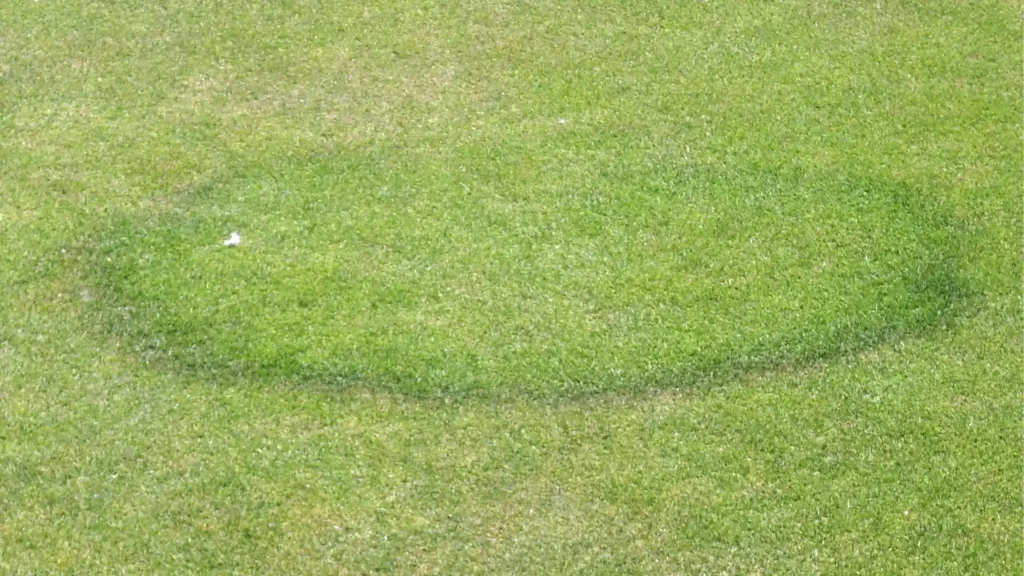
Fairy Ring: Produces circular or arc-shaped rings of dark green grass, sometimes with mushrooms along the ring. The fungus feeds on organic matter underground and releases nitrogen, which explains the dark ring. In severe cases it creates a water-repellent layer in the soil that starves the turf above it.
What Makes Northwest Arkansas Lawns Vulnerable
Our summer climate is about as favorable for fungal disease as it gets. Hot days, warm nights, and the kind of thick humidity that settles in during July and August create the exact conditions that lawn pathogens prefer.
Add in the dense canopy of a thick fescue lawn that does not dry out between waterings, irrigation cycles running late at night and leaving the surface wet for hours, and the heavy clay soil that holds moisture longer than sandy soil does, and you have a recipe for disease pressure every single summer.
Lawns that have had disease problems before are more likely to experience them again because many fungal pathogens overwinter in the thatch layer or soil and reactivate when conditions are right. If you have dealt with brown patch two summers in a row, you should expect it again without a program in place to reduce its impact.
What Not to Do When You Suspect Disease
Stop watering at night. I know it sounds convenient, but nighttime irrigation leaves the surface wet for the entire night, which is exactly the window that most fungal pathogens need to spread.
Do not fertilize. Nitrogen feeds the grass, but it also feeds the disease. High nitrogen in a lawn already fighting brown patch or pythium is one of the fastest ways to make a manageable problem into a serious one.
Do not mow aggressively. Mowing spreads fungal spores across the lawn through the clippings and the mower deck. If you mow a diseased area and then cross into a healthy area without cleaning the deck, you are moving the disease with you.
Get a diagnosis first. A fungicide applied to the wrong disease, or to a lawn that does not actually have disease, is wasted money and potentially harmful to turf that is already stressed. A professional assessment takes the guesswork out.
When and How Fungicide Treatment Works
Fungicides work best as a preventive or early-intervention tool. Once a fungal disease has killed the crowns of the grass plants in an affected area, no fungicide brings those plants back. It stops the spread. It does not reverse existing damage.
If you have a history of brown patch or pythium in your lawn, preventive fungicide applications timed to just before the conditions that trigger disease can keep problems from getting established. For homeowners who want to be proactive about disease, this is usually the most cost-effective approach.
For active disease, a curative fungicide application can stop progression and protect the healthy turf around the affected area while the damaged sections recover or are overseeded.
Frequently Asked Questions
Q: Can I treat lawn disease myself with a store-bought fungicide?
A: Some consumer fungicide products are available and can help with mild cases. The challenge is identifying the disease correctly, choosing the right product, and applying it at the right rate and timing. A wrong diagnosis or wrong product selection often produces no result and delays effective treatment.
Q: My lawn had brown patch last summer. Will it come back?
A: Probably, unless conditions change or a preventive program is in place. The pathogen overwinters in the soil and thatch and reactivates when temperatures and humidity are right. Improving air circulation, adjusting irrigation timing to morning, and a preventive fungicide application before peak disease season are your best defenses.
Q: Does aeration help with lawn disease?
A: It can. Aeration reduces thatch buildup, which is where many fungal pathogens harbor between seasons. It also improves drainage and air movement through the soil, creating conditions that are less favorable for disease development. It is not a disease treatment on its own, but it supports overall lawn health in ways that reduce vulnerability.
Q: How do I know if the damaged areas will grow back after disease treatment?
A: It depends on whether the crown of the grass plant survived. Tug on a small section of the damaged turf. If the roots hold, the plant can recover. If it pulls up without resistance, the crown is dead and those areas need reseeding. Most disease-affected lawns have a mix of both.
Q: Does mowing height affect disease risk?
A: Yes. Mowing fescue too short removes the leaf tissue the plant needs and creates stress that increases disease susceptibility. Keeping fescue at 3.5 to 4 inches maintains a canopy that moderates soil temperature and retains some moisture, but it also requires careful irrigation management because dense turf can stay wet longer.
Q: Can warm-season grasses get fungal disease too?
A: Yes, though warm-season grasses like Bermuda and Zoysia are generally more disease-resistant than tall fescue in our climate. They can still be affected by dollar spot, gray leaf spot, and other diseases, particularly when over-fertilized with nitrogen during hot weather or when drainage is poor.
Conclusion
If your lawn has circular brown patches, a greasy or webbed texture on the turf surface, or damage that appeared suddenly during a hot and humid stretch, do not reach for more water or more fertilizer. Those are the two most common ways homeowners make a disease problem worse.
Look at the pattern. Consider the timing. If disease is the likely culprit, get a professional assessment before you treat. The right fungicide at the right time stops disease in its tracks. The wrong response spreads it.
At 1st Impressions Lawn and Tree, we diagnose and treat lawn disease for homeowners across Rogers, Bentonville, Springdale, and Fayetteville. Call (479) 426-4644 or email info@1stimpressionslawntree.com if you are seeing something that does not look right. We would rather help you catch it early. Better Lawn. Better Living.