Why This Happens
Fungal pathogens that cause lawn disease are naturally present in most soils. They cause no harm when conditions do not favor their growth. When temperature, moisture, and turf health align in specific ways, those pathogens multiply rapidly and begin damaging grass plants.
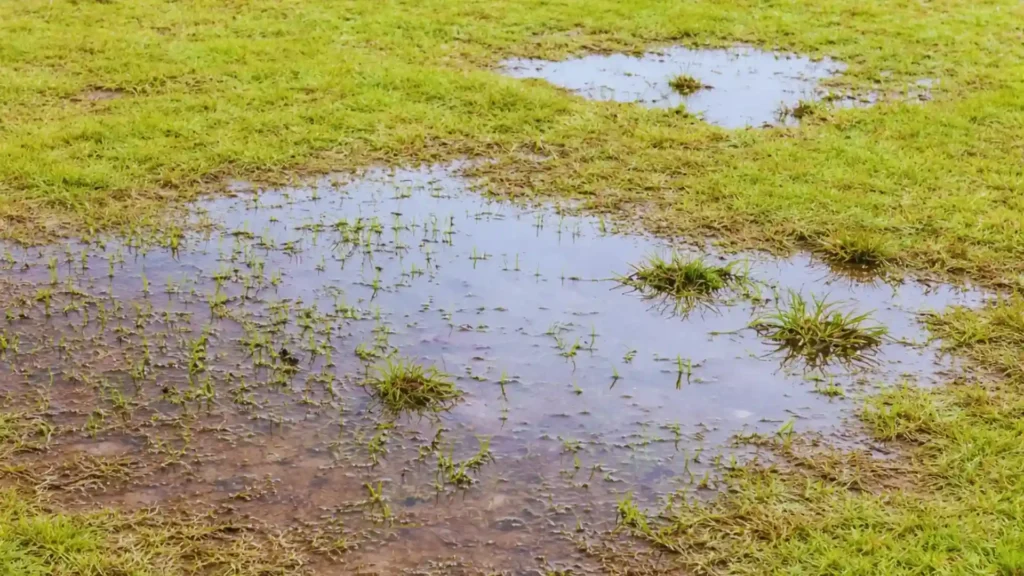
Water is the critical variable. Fungi need moisture to germinate and spread. Turf that stays wet overnight, whether from evening irrigation, poor drainage, or high humidity with no airflow, provides the sustained moisture that allows fungal spores to germinate on leaf surfaces and penetrate plant tissue. This is why brown patch, the most common summer disease in Northwest Arkansas, typically appears first in low-lying areas, shaded zones, or areas with irrigation overlap that receive more moisture than surrounding turf.
The relationship is not simply more water equals more disease. Timing matters as much as volume. A lawn watered heavily in the morning that dries completely during the day is far less disease-susceptible than a lawn watered lightly in the evening that stays damp overnight. The duration of leaf wetness, not just the amount of water applied, is the primary moisture-related disease driver.
What Most Homeowners Get Wrong
The most common mistake is watering in the evening or at night for convenience. This keeps turf wet through the warmest, most humid part of the night, which is the exact window when fungal pathogens are most active. Switching to early morning irrigation so turf dries completely during the day is one of the highest-impact cultural changes a homeowner can make for disease prevention.
The second mistake is assuming that reducing water will eliminate an active disease. Once lawn disease is established and actively spreading, reducing moisture slows it but does not stop it. Active disease requires fungicide treatment. Cultural changes including irrigation timing adjustment are prevention measures and disease management support, not the primary treatment.
Poor airflow is the water-adjacent factor that many homeowners overlook. Trees, dense shrubs, and structures that limit wind movement through the lawn create microclimates where humidity accumulates and turf stays wet longer after rain or irrigation. These areas develop disease pressure even with correct irrigation timing because the environment itself maintains the leaf wetness conditions that drive infection.
What Actually Works
For disease prevention: switch all irrigation to early morning, ideally completing watering by 8 to 9 AM so turf dries during peak daytime temperatures. Trim tree canopy where possible to improve airflow and light penetration in shaded areas. Avoid high-nitrogen fertilization in summer, which pushes the soft, lush growth that is most susceptible to fungal attack.
Annual aeration reduces disease risk by improving soil drainage. Compacted soil holds surface moisture longer and creates the waterlogged conditions at the root zone that compound disease pressure. Improved drainage through consistent aeration directly reduces one of the environmental factors that favor disease development.
For active disease: apply a systemic fungicide and implement all cultural adjustments simultaneously. A second application 14 to 21 days after the first is typically needed to fully control an outbreak. After disease pressure subsides in fall, overseed damaged areas and begin a lawn disease treatment monitoring program for the following season.
How This Applies in Northwest Arkansas
Northwest Arkansas summer humidity is consistently high enough that even correctly-timed irrigation can leave turf in a disease-susceptible moisture state. The warm, humid nights typical of July and August in Fayetteville, Rogers, Bentonville, and Springdale combine with afternoon thunderstorms that re-wet turf at exactly the wrong time of day.
Fayetteville properties with significant tree cover experience this most severely. The canopy traps humidity, limits airflow, and keeps both soil and leaf surfaces wet for longer periods after rain. These properties benefit most from preventive fungicide applications in June before disease season peaks rather than waiting for visible symptoms to appear.
Properties with soil compaction are also disproportionately affected because compacted clay drains slowly after rainfall, keeping the root zone and surface wet for days after a significant rain event. This is one more reason why annual aeration is not optional for disease management in our region.
Get a Lawn Care Plan That Works
At 1st Impressions Lawn and Tree, lawn disease management is built into our complete lawn care programs as a preventive priority in high-risk seasons rather than a reactive response after damage has occurred. Irrigation timing guidance, annual aeration for improved drainage, and preventive or responsive fungicide applications are all part of a coordinated approach.
Concerned about fungal disease in your lawn? Contact 1st Impressions Lawn and Tree for a professional evaluation in Northwest Arkansas.